"[T]he State's criminality is nothing new and nothing to be wondered at. It began when the first predatory group of men clustered together and formed the State, and it will continue as long as the State exists in the world, because the State is fundamentally an anti-social institution, fundamentally criminal. The idea that the State originated to serve any kind of social purpose is completely unhistorical. It originated in conquest and confiscation -- that is to say, in crime. It originated for the purpose of maintaining the division of society into an owning-and-exploiting class and a propertyless dependent class -- that is, for a criminal purpose. No State known to history originated in any other manner, or for any other purpose. Like all predatory or parasitic institutions, its first instinct is that of self-preservation. All its enterprises are directed first towards preserving its own life, and, second, towards increasing its own power and enlarging the scope of its own activity. For the sake of this it will, and regularly does, commit any crime which circumstances make expedient."
Quote by: Albert Jay Nock (1870-1945)
Source: The Criminality of the State, America Mercury Magazine, March, 1939
Addition (July 8): Perhaps this post deserves some explanation. I've been thinking about the nature of the state, and I came across this statement from Nock that reflected my thoughts. It seems that everyone uncritically accepts the feel-good description of the state that we've been fed in childhood: "the state exists to maintain public order" or "to serve the public good" or whatever. However, if we just look at the history of the state and its current structure, there is nothing to justify those views. Those are just explanations dreamed up by apologists after the fact to justify the state. The purpose of the state is rather clear: the state exists to concentrate power into the hand of a privileged elite. That elite will do what they want with that power, and there's no reason to believe that they will be any more benevolent than the average person would be, if power were allowed to be rather diffuse. In fact, there's good reason to believe that the elite will tend to be selfish, megalomaniacal, and generally destructive.
The institution of elections helps to reign in the elite, but does not change the fundamental nature of the state. In the end, elections just serve to confuse every issue. Rather than being you and I sitting down and figuring out how to manage our conflicts of interests in a mutually acceptable way, we are driven to manage our conflict through this incredibly complex institution that neither of us really understand, and neither of have any meaningful control over. In the end, every conflict turns into a power-play: one of us wins, and the other loses (and often, we both lose).
Friday, July 07, 2006


Tuesday, June 27, 2006
Different kinds of elites (and different kinds of elitism) | quixotic1.com
Interesting post at an interesting blog:
Different kinds of elites (and different kinds of elitism) | quixotic1.com
Different kinds of elites (and different kinds of elitism) | quixotic1.com
It seems important to me to keep these different types of elites in mind as we think about the intersections of technology and social change. One way of achieving change is by appealing to the state's powerholders — traditional power, that is. But throughout history, coalitions of people without this power have banded together to effect change. It may be that among the three other types of elites, a social movement can emerge that represents true democratic change.
Saturday, June 17, 2006
New York decriminalizes the female body: This is what it looks like
Originally published at the Freedom Democrats site, please comment there.
I just stumbled upon a collection of photos by Jordan Matter of all types of women going topless in NYC.
It took me a few minutes to get used to the images of topless women on the street, but eventually it started to look natural. Two pictures really emphasized how natural it is: one of a woman breast-feeding in the park, and another showing an older couple running up the steps from Penn Station with their shirts off.
There's also a video on the front page of Jordan Matter's website, which includes the photographer reading (bare-chested) from a court decision striking down laws that prohibit women from going bare chested just like men.
The USA has eliminated a lot of sexism from its laws, but we're not quite finished yet.
I just stumbled upon a collection of photos by Jordan Matter of all types of women going topless in NYC.
It took me a few minutes to get used to the images of topless women on the street, but eventually it started to look natural. Two pictures really emphasized how natural it is: one of a woman breast-feeding in the park, and another showing an older couple running up the steps from Penn Station with their shirts off.
There's also a video on the front page of Jordan Matter's website, which includes the photographer reading (bare-chested) from a court decision striking down laws that prohibit women from going bare chested just like men.
The USA has eliminated a lot of sexism from its laws, but we're not quite finished yet.
Voting guide: support the opposition
I've been meaning to write up a little "Guide for the common voter", to express my ideas on how regular folk should approach elections.
Basically, elections are a big waste of time and effort; no regular person has any hope of influencing the outcome of an election.
But regular folk should still vote. We should just get in, pull the lever, get out, and get back to doing the real work of the world (because we know that the politicians and lobbyists aren't doing anything useful).
However, an miscast vote is no better, and possibly worse, than no vote at all. Is there any way that we can quickly come to a decision on who to vote for, but still be confident that we will generally vote for the "right person"?
In this article, I propose two strategies for quick and efficient voting: vote for gridlock, and vote for change. They are both based on the observation that "power corrupts".
Vote for gridlock: When one party controls all branches of government, the government goes to shit. The opposition party is powerless to force accountability on the dominant party. Basically, the dominant party just uses its power to steal everything it can get its hands, and divides the spoils among its politicians, its campaign donors, and its voting constituencies. When power is split between the parties, each party will have the ability to hold the other accountable for any abuse of power, and legislation will only get established with near-consensus. So, if power is not evenly divided between the two major parties, vote for the candidate from the weaker of the two parties.
There's a nice piece on this from Reason: Vote for Gridlock: It's the patriotic thing to do
Before we end, I'd like to address one common objection to these strategies: both of these strategies decrease the power of the elected representative from the voter's district, but a voter should want his representatives to have more power to advance the interests of his district. Poppycock. This is a simple choice between advancing parochial interests or advancing the general interest. Voters are free to use their votes to support the interests of a narrow group in society, and many (if not most) voters do just that. However, a narrow approach to politics undermines the entire purpose of having a political union. If voters are acting out of selfish aims, we should just dissolve the government, and end this farce.
Basically, elections are a big waste of time and effort; no regular person has any hope of influencing the outcome of an election.
But regular folk should still vote. We should just get in, pull the lever, get out, and get back to doing the real work of the world (because we know that the politicians and lobbyists aren't doing anything useful).
However, an miscast vote is no better, and possibly worse, than no vote at all. Is there any way that we can quickly come to a decision on who to vote for, but still be confident that we will generally vote for the "right person"?
In this article, I propose two strategies for quick and efficient voting: vote for gridlock, and vote for change. They are both based on the observation that "power corrupts".
Vote for gridlock: When one party controls all branches of government, the government goes to shit. The opposition party is powerless to force accountability on the dominant party. Basically, the dominant party just uses its power to steal everything it can get its hands, and divides the spoils among its politicians, its campaign donors, and its voting constituencies. When power is split between the parties, each party will have the ability to hold the other accountable for any abuse of power, and legislation will only get established with near-consensus. So, if power is not evenly divided between the two major parties, vote for the candidate from the weaker of the two parties.
There's a nice piece on this from Reason: Vote for Gridlock: It's the patriotic thing to do
Politicians are like diapers; they need to be changed often and for the same reasons.
Vote for change: If it isn't clear how to produce greater gridlock, then just vote against the incumbent. Incumbency provides too of a re-election advantage, and too much power in Washington. A constant turnover among politicians assures that they don't forget what its like to have a real job, and also provides the people with a constant supply of ex-politicians who can openly debrief us on what they saw in the halls of power.Before we end, I'd like to address one common objection to these strategies: both of these strategies decrease the power of the elected representative from the voter's district, but a voter should want his representatives to have more power to advance the interests of his district. Poppycock. This is a simple choice between advancing parochial interests or advancing the general interest. Voters are free to use their votes to support the interests of a narrow group in society, and many (if not most) voters do just that. However, a narrow approach to politics undermines the entire purpose of having a political union. If voters are acting out of selfish aims, we should just dissolve the government, and end this farce.
Friday, June 09, 2006
Know your place
I recently stumbled upon a friend's copy of Jack Welch's recent management book: Winning.
Being familiar with Kevin Carson's analysis of the motivational propaganda put out by corporate management, I was wondering if this book espoused the same rankist ideology.
Looking at the Table of Contents, one chapter subtitle caught my eye: "That damn boss". So, what does the great Jack Welch have to say about disliking your boss?
I was pleasantly surprized that he quickly got to business by recognizing that "The world has jerks. Some of them get to be bosses."
However, for the most part, he goes on to advise the reader to just deal with it and hope for protection within the system. He phrases this in terms of "don't be a victim"--which on one hand is sensible and self-empowering: you don't give up on your life or your career just because you have a bad boss. On the other hand, among the "victim" behaviors he includes "bitching and moaning to your coworkers." I don't see anything wrong with expressing your opinions and concerns with people who might have some insights into the situation or might be able to help you overcome this crappy situation. Yes, it is painting yourself as a victim, but you may have actually be in an unjust situation. The solution to victimization is to find effective remedies for the injustice. By saying that we shouldn't even discuss any victimization we experience, Welch seems to suggest that there's nothing to be done about it, and we should just "deal with it."
He goes on to suggest that quiting is not a real option: He describes the outcome as being "out on the market, with no recommendations...". You might need to quit as a last resort, but you have to realize that your current boss not only controls your day-to-day worklife, he controls your future prospects as well. So much for free markets.
Next, he examines reasons why your boss might treat you like dung. One possible explanation is that you are a "boss hater", and your boss is just reflecting your own attitude on you (amplified tenfold, of course). You might be able to get away with this attitude if you are really talented, but most poor schmucks can't pull it off.
So basically, unless you are really sure of yourself, you should just give everything you've got to your boss and hope that he's a reasonable person and will reward you. If he isn't, you can really only hope that the corporate system will solve your problems: the higher-ups will eventually learn that you are a good worker and the boss is a bad boss, and will put you out of your misery by transferring you or firing him. You can cross your fingers and hope for this emancipation from above, but of course there is rarely a formal remedy built into the system, and talking to the boss' boss is generally counterproductive.
He finishes the meat of this chapter by saying that you need to decide whether to endure the bad boss or quit. Then you need to "come to grips with the fact that you are staying with a bad boss by choice. That means you've forfeited your right to complain." Of course, you owe your boss your unswerving loyalty. Know your place, slave.
I don't doubt that Welch is dispensing sincere advice, unlike the cynical crap put forward in Fish! and Who Moved My Cheese?, but the takehome message is still the same: you are not a free person. The (economic) world is not structured around the exchange of goods and services among equals; instead, it is a huge hierarchy and the only way you can move up (or get out from under the others) is to play the game and win the good graces of those who are already at the top.
Being familiar with Kevin Carson's analysis of the motivational propaganda put out by corporate management, I was wondering if this book espoused the same rankist ideology.
Looking at the Table of Contents, one chapter subtitle caught my eye: "That damn boss". So, what does the great Jack Welch have to say about disliking your boss?
I was pleasantly surprized that he quickly got to business by recognizing that "The world has jerks. Some of them get to be bosses."
However, for the most part, he goes on to advise the reader to just deal with it and hope for protection within the system. He phrases this in terms of "don't be a victim"--which on one hand is sensible and self-empowering: you don't give up on your life or your career just because you have a bad boss. On the other hand, among the "victim" behaviors he includes "bitching and moaning to your coworkers." I don't see anything wrong with expressing your opinions and concerns with people who might have some insights into the situation or might be able to help you overcome this crappy situation. Yes, it is painting yourself as a victim, but you may have actually be in an unjust situation. The solution to victimization is to find effective remedies for the injustice. By saying that we shouldn't even discuss any victimization we experience, Welch seems to suggest that there's nothing to be done about it, and we should just "deal with it."
He goes on to suggest that quiting is not a real option: He describes the outcome as being "out on the market, with no recommendations...". You might need to quit as a last resort, but you have to realize that your current boss not only controls your day-to-day worklife, he controls your future prospects as well. So much for free markets.
Next, he examines reasons why your boss might treat you like dung. One possible explanation is that you are a "boss hater", and your boss is just reflecting your own attitude on you (amplified tenfold, of course). You might be able to get away with this attitude if you are really talented, but most poor schmucks can't pull it off.
So basically, unless you are really sure of yourself, you should just give everything you've got to your boss and hope that he's a reasonable person and will reward you. If he isn't, you can really only hope that the corporate system will solve your problems: the higher-ups will eventually learn that you are a good worker and the boss is a bad boss, and will put you out of your misery by transferring you or firing him. You can cross your fingers and hope for this emancipation from above, but of course there is rarely a formal remedy built into the system, and talking to the boss' boss is generally counterproductive.
He finishes the meat of this chapter by saying that you need to decide whether to endure the bad boss or quit. Then you need to "come to grips with the fact that you are staying with a bad boss by choice. That means you've forfeited your right to complain." Of course, you owe your boss your unswerving loyalty. Know your place, slave.
I don't doubt that Welch is dispensing sincere advice, unlike the cynical crap put forward in Fish! and Who Moved My Cheese?, but the takehome message is still the same: you are not a free person. The (economic) world is not structured around the exchange of goods and services among equals; instead, it is a huge hierarchy and the only way you can move up (or get out from under the others) is to play the game and win the good graces of those who are already at the top.
Monday, May 29, 2006
Mises Economics Blog: Abolish the Alcohol and Tobacco Tax and Trade Bureau
Mises Economics Blog: Abolish the Alcohol and Tobacco Tax and Trade Bureau (TTB)
From the TTB website:
Distillation of Ethanol - In recent days, we have seen several news items on people distilling ethanol at home to supplement their gasoline needs. Unfortunately, some of the reports do not inform the public that it is illegal to distill alcohol without first obtaining a Federal permit through the Alcohol and Tobacco Tax and Trade Bureau (TTB). Failure to obtain a Federal permit prior to engaging in this activity is a criminal offence under the Internal Revenue Code.
From the TTB website:
Distillation of Ethanol - In recent days, we have seen several news items on people distilling ethanol at home to supplement their gasoline needs. Unfortunately, some of the reports do not inform the public that it is illegal to distill alcohol without first obtaining a Federal permit through the Alcohol and Tobacco Tax and Trade Bureau (TTB). Failure to obtain a Federal permit prior to engaging in this activity is a criminal offence under the Internal Revenue Code.
Mises Economics Blog: Abolish the Alcohol and Tobacco Tax and Trade Bureau
Mises Economics Blog: Abolish the Alcohol and Tobacco Tax and Trade Bureau (TTB)
From the TTB website:
Distillation of Ethanol - In recent days, we have seen several news items on people distilling ethanol at home to supplement their gasoline needs. Unfortunately, some of the reports do not inform the public that it is illegal to distill alcohol without first obtaining a Federal permit through the Alcohol and Tobacco Tax and Trade Bureau (TTB). Failure to obtain a Federal permit prior to engaging in this activity is a criminal offence under the Internal Revenue Code.
From the TTB website:
Distillation of Ethanol - In recent days, we have seen several news items on people distilling ethanol at home to supplement their gasoline needs. Unfortunately, some of the reports do not inform the public that it is illegal to distill alcohol without first obtaining a Federal permit through the Alcohol and Tobacco Tax and Trade Bureau (TTB). Failure to obtain a Federal permit prior to engaging in this activity is a criminal offence under the Internal Revenue Code.
Wednesday, May 24, 2006
Threats to equality on the internet
There are currently two bills before the US House of Representatives that could greatly impact the continuation of egalitarian communication on the internet.
The first is Michael Fitzpatrick's (R-PA) Deleting Online Predators Act, which would create a Federal mandate that schools and libraries "prohibit access by minors to commercial social networking websites", which are websites that "allow users to create web pages or profiles that provide information about themselves and are available to other users and offer a mechanism for communication with other users."
Basically, if this law worked perfectly, this would block minors from viewing any commercial website where a regular person can add content, and where users create accounts and user's pages. In reality, schools and libraries will probably be error on the side of caution, and end up interfering with web-use by adults, and also block sites that are non-commercial. This would impact almost every interactive part of the web, including Blogger, Wikipedia, and community sites like Daily Kos. A person who relies on a library or school computer for internet access would be limited to static websites that are created and maintained by those with immense financial resources, or the random junk that "regular folk" are able to post on the web somewhat independently.
This legislation is a major over-reaction to the problem of online predators for two reasons:
For more info and discussion, see: Freedom Democrats
Update:
The second bill opposes the adoption of content discrimination by internet service providers. John Conyer's (D-MI ) Internet Freedom and Nondiscrimination Act, would mandate "Net Neutrality"--that ISPs cannot discriminate among content providers. Without this provision, ISPs would probably provide preference to content providers who are able to shell out the big bucks for fast data transmission. I doubt consumers would even be aware of the reason why some sites are faster than others, and would just stop using the slow sites, assuming that it's a server problem.
I'm not thrilled about restrictions like this, but I think it would be a good idea to place a moratorium on any content discrimination, in order to allow consumers some time to figure out how to deal with this. If ISPs are going to discriminate among content-providers, they should be limited to doing it in situations where they are providing the consumer with a free connection, or they are explicitly telling the end-user that a particular connection is slow because the ISP chose to give that connection a lower priority.
For more info and discussion, see: Freedom Democrats
Update: A bunch of links for discussion on this issue:
The first is Michael Fitzpatrick's (R-PA) Deleting Online Predators Act, which would create a Federal mandate that schools and libraries "prohibit access by minors to commercial social networking websites", which are websites that "allow users to create web pages or profiles that provide information about themselves and are available to other users and offer a mechanism for communication with other users."
Basically, if this law worked perfectly, this would block minors from viewing any commercial website where a regular person can add content, and where users create accounts and user's pages. In reality, schools and libraries will probably be error on the side of caution, and end up interfering with web-use by adults, and also block sites that are non-commercial. This would impact almost every interactive part of the web, including Blogger, Wikipedia, and community sites like Daily Kos. A person who relies on a library or school computer for internet access would be limited to static websites that are created and maintained by those with immense financial resources, or the random junk that "regular folk" are able to post on the web somewhat independently.
This legislation is a major over-reaction to the problem of online predators for two reasons:
- This can be handled directly by schools and libraries. Washington should only provide guidance and tools such as software.
- This can be handled without blocking websites. A simple solution is to turn off "cookies" on the computers' web browsers, such that users are not able to log-on to their accounts, and consequently can't receive messages sent to them or add personal information.
For more info and discussion, see: Freedom Democrats
Update:
- Fitzpatrick is being challenged by Patrick Murphy in November 2006
- American Library Association opposes DOPA (from CountSwackula)
The second bill opposes the adoption of content discrimination by internet service providers. John Conyer's (D-MI ) Internet Freedom and Nondiscrimination Act, would mandate "Net Neutrality"--that ISPs cannot discriminate among content providers. Without this provision, ISPs would probably provide preference to content providers who are able to shell out the big bucks for fast data transmission. I doubt consumers would even be aware of the reason why some sites are faster than others, and would just stop using the slow sites, assuming that it's a server problem.
I'm not thrilled about restrictions like this, but I think it would be a good idea to place a moratorium on any content discrimination, in order to allow consumers some time to figure out how to deal with this. If ISPs are going to discriminate among content-providers, they should be limited to doing it in situations where they are providing the consumer with a free connection, or they are explicitly telling the end-user that a particular connection is slow because the ISP chose to give that connection a lower priority.
For more info and discussion, see: Freedom Democrats
Update: A bunch of links for discussion on this issue:
- ALA supports Net Neutrality (from CountSwackula)
- A neutral panic (against Net Neutrality, via Kevin Carson)
Tuesday, May 02, 2006



Wednesday, April 26, 2006
Ownlife
Kevin Carson has been harping of the motivational techniques used by management to get workers to do more work for less pay (i.e. "increase efficiency"), with a particular focus on books that are apparently assigned reading in some corporations. Part of this is a reflection on management's attitude that people should love their jobs, regardless of what their jobs are. He describes management's conundrum as follows:
"It takes a lot of effort to get people's minds right and stamp out those last vestiges of ownlife. And surprise, surprise, surprise: there's an entire Motivational Mafia out there focused on getting people to love Big Brother and think of their jobs as the center of their life. "I was especially drawn to a new word that he used: "ownlife". As a kid, I read most of Fred Sabrahagen's Berserker series of stories, in which the genocidal (or "biocidal") machines refer to their human servants as "goodlife", while all other life is implicitly "badlife" due to its innate desire to survive. Using this style of terminology, "ownlife" would be lifeforms that insist on purusing their own ends; but what would be the opposite? Ownedlife? Worklife?
Sunday, April 09, 2006
Ripple: An Online community currency system
I've been interested in community currency systems for awhile, and was pleased to discover Ripple-pay while reading the Mutualist Blog. For more info, check out "about ripple-pay", the "Ripplepay FAQ", and the Ripple Project sourceforge homepage.
I'll cover two issues in this post: first, why Ripple is better than other community currency systems that I've heard of, and second: why we should bother developing community currency systems.
Ripple is special because anyone can get into the system just by opening an account with the website/server. However, you can't do anything until you get someone to extend a line of credit to you (either a merchant or a friend) or you agree to accept someone else's IOU in exchange for services. This feature is dependent upon the main innovation of Ripple: there is no centralized organizer for the system -- it is based on one-on-one relationships between users, and the community dynamics develop from the network created by pairs of users. Consequently, each individual can understand the system and his own role in it.
However, this still allows particular users (accounts) to serve as connector nodes-- for example, a merchant may be willing to accept IOUs from many of his customers (so he can move his wares quickly), and likewise many of his customers may be willing to accept IOUs from the merchant because they know that they can exchange those IOUs for the goods that he sells. Another type of connector would be a credit-rating agent-- a trusted intermediate-- who makes a living from judging whether individuals are creditworthy and then exchanging his own, (widely-accepted) IOUs for their IOUs.
Why bother with community currencies? I believe that people should have control over their own lives, and that means that they should have control over the material items and social institutions that are necessary for their survival. Most of us need money to put a roof over our heads and food in our bellies, so it bothers me that our money system is controlled by distant, effectively anonymous bankers in NYC and politicians in Washington who are hardly accountable to regular Americans. In America and around the world, these elite-run monetary systems have repeatedly failed and driven millions of regular people to desperation. The most recent example in the USA was during the Great Depression, but these currency crises still happen on a regular basis around the world, and I doubt the politicians when they claim that the USA has developed the magical system that will never fail.
I prefer to have a system that lets me know where my dependencies lay, and gives me control over maintaining them, and rebuilding them in the case that there is a systemic breakdown. That's why I support the development of community currency systems.
Addendum: To paraphrase Douglas Adams : "If a system is labeled as 'unbreakable', you can be sure that there will be no way to fix it when it breaks".
Additions: Some similar credit systems from the Salon.com article "The virtual moneylender" . However, these are profit oriented.
I'll cover two issues in this post: first, why Ripple is better than other community currency systems that I've heard of, and second: why we should bother developing community currency systems.
Ripple is special because anyone can get into the system just by opening an account with the website/server. However, you can't do anything until you get someone to extend a line of credit to you (either a merchant or a friend) or you agree to accept someone else's IOU in exchange for services. This feature is dependent upon the main innovation of Ripple: there is no centralized organizer for the system -- it is based on one-on-one relationships between users, and the community dynamics develop from the network created by pairs of users. Consequently, each individual can understand the system and his own role in it.
However, this still allows particular users (accounts) to serve as connector nodes-- for example, a merchant may be willing to accept IOUs from many of his customers (so he can move his wares quickly), and likewise many of his customers may be willing to accept IOUs from the merchant because they know that they can exchange those IOUs for the goods that he sells. Another type of connector would be a credit-rating agent-- a trusted intermediate-- who makes a living from judging whether individuals are creditworthy and then exchanging his own, (widely-accepted) IOUs for their IOUs.
Why bother with community currencies? I believe that people should have control over their own lives, and that means that they should have control over the material items and social institutions that are necessary for their survival. Most of us need money to put a roof over our heads and food in our bellies, so it bothers me that our money system is controlled by distant, effectively anonymous bankers in NYC and politicians in Washington who are hardly accountable to regular Americans. In America and around the world, these elite-run monetary systems have repeatedly failed and driven millions of regular people to desperation. The most recent example in the USA was during the Great Depression, but these currency crises still happen on a regular basis around the world, and I doubt the politicians when they claim that the USA has developed the magical system that will never fail.
I prefer to have a system that lets me know where my dependencies lay, and gives me control over maintaining them, and rebuilding them in the case that there is a systemic breakdown. That's why I support the development of community currency systems.
Addendum: To paraphrase Douglas Adams : "If a system is labeled as 'unbreakable', you can be sure that there will be no way to fix it when it breaks".
Additions: Some similar credit systems from the Salon.com article "The virtual moneylender" . However, these are profit oriented.
Friday, March 10, 2006
Controlling our information
Despite the amazing information technologies (IT) being developed, many of us fail to gain the promised benefits because we don't consider how some of these technologies deprive us of control over our information. We end up giving away this control and consequently our future options are limited. Before IT consumers invest in learning new IT systems and entering our information into these systems, we need to evaluate whether we retain control over that information once it is in the system.
I expect all IT systems to embody the following guideline:
All information entered into the system by the user may be reused by that user without any technological or legal barriers.
While I don't expect any software to follow that guideline perfectly, I have noticed great variation in the extent that different IT systems follow it, and this has become a major factor in my choice of which software to use. The most important consideration is that the software supports open file formats, though the user interface and structure of the IT system itself can also be factors.
So here are the practical applications of this rule:
My music player must support OGG Vorbis, as all of my CDs have been ripped into that format. Good bye iTunes (and iPod). Hello Winamp (with appropriate plug-ins)
My office suite must support the Open Document standard. Good bye MS Office, hello OpenOffice.org and StarOffice. Here's a good article about Open Office: OpenOffice Is 10 Years Behind MS Office? That's Fine!
I'm am wary of Google's offers to store all of my data on their servers (starting with Gmail, and extending to Gdrive). The benefits are too small, and aside from privacy concerns, there's too much risk that they'll keep me from easily recovering all of my information and moving it to a new service.
Rant: I really dislike Apple Computers. They have always seemed to be control freaks, and while they may have relaxed their grip a little, I still think they're worse than Microsoft in this respect. I was also frustrated that iTunes displays RSS Podcast addresses in such a way that the user can't select the text and copy it to the clipboard, which meant I had to copy the addresses into Winamp by hand. Limiting the user in this way is either a stupid oversight on the part of the designers, or an intentional scheme to limit their options.
Sunday, January 29, 2006
Mutualist blog: Who Moved My Cheese, Revisited
I don't have time to write anything about this, but Kevin Carson wrote a good post about the constant propaganda campaigns of the powers-that-be to convince the powerless that their condition "natural" and inevitable.
Mutualist Blog: Free Market Anti-Capitalism: Who Moved My Cheese, Revisited
Mutualist Blog: Free Market Anti-Capitalism: Who Moved My Cheese, Revisited
Change...is something that "just happens"; it's presented in much the same way Tom Friedman presents "globalization": not as the product of human action, but as an inevitable and impersonal force of nature. We're expected to accept as it comes, and deal with it within whatever framework is established by (those who control our social institutions). The idea that some authority figures are in a position to dole out cheese, and that we must jump through whatever hoops they require in order to get it, goes without saying.
Sunday, January 08, 2006
Promoting the rule of law (the death penalty, and public defenders)
Originally published at the Freedom Democrats site
America prides itself on being a land of laws. We can rest easy, knowing that if we have broken no law, the police will not bother us.
The Bush administration has recently shaken our confidence in this fact: they assert a right to spy on and even imprison American citizens on American soil, without any reference to those individuals having violated a law. This is a troubling development, but for some segments of American society, the rule of law has always stood on a shaky foundation.
Americans are regularly arrested despite having committed no crime, and most are found "not guilty" after standing trial before their peers, yet some are wrongfully convicted. The American legal system is designed to err on the side of liberty--guilt must be proven "beyond a reasonable doubt"-- so we might be tempted to accept that any wrongful punishments are the unavoidable side-effect of a human system that punishes the guilty.
We shouldn't dismiss this so easily. Wrongful conviction and punishment is the greatest infringement on personal liberty possible by the government in our society, and eliminating wrongful punishments should be a top priority for anyone concerned with liberty or fairness in our society.
I generally don't feel qualified to judge the legitimacy of individual convictions, but I can judge the system as a whole, and I know that the United States of America are punishing, even executing, individuals who did not commit the crimes that they were convicted of. Even worse, I know that Americans from particular communities are much more likely to be wrongfully convicted than other Americans, and I know that these wrongful convictions and punishments are not necessary.
We should take all reasonable measures to minimize wrongful punishments, but we don't. To minimize wrongful punishments, we should severely limit the use of the death penalty, and provide any funds necessary to provide legal consul to indigent Americans who have been arrested.
For information about wrongful execution, see Science versus the Death Penalty at Scientific American Observations. And for a lyrical representation of a wrongful execution, see Johnny Cash's song, The Long Black Veil.
The issue of public provision of legal consul for indigent defendants is a bit more complicated than the death penalty. Often, the state claims that it just doesn't have the money to provide adequate defense. As critics of government profligacy, readers of this blog may be sympathetic with the view that criminal defendants should be left to find their own lawyers. However, we must remember that the loss of freedom that comes from our current tax rate is completely insignificant in comparison to the loss of freedom that comes from wrongful imprisonment, and the cost of a fully funded public defender's office is insignificant in comparison to other expenditures of state governments. Also, we should recognize that the defendants legal costs are generally imposed by a state that constantly criminalizes additional activities, and these costs should be treated as an unavoidable part of the criminalization of any activity.
For information about providing an adequate defense for indigent criminal defendants, see the American Bar Association's Ten Principles of a Public Defense System (PDF) and the ACLU's website on justice for the indigent.
To get an idea of how this issue is treated in public discourse, check out this editorial from the Virginia-Pilot, Indigent defense loses out again, and how Virginia measures up using the American Bar Association's evaluation system, rated by the Virginia Indigent Defense Coalition.
Finally, for some perspective, consider the view of a poor person living in a poor community. In addition to the risk of being the victim of street-crime, this person may also worry about police harassment and the risk of being convicted of a crime that he did not commit. If he views the police as a threat to himself and his loved ones, he will likely be filled with fear and anger, and will undermine fundamental societal institutions. The risk of wrongful imprisonment may be viewed as part of an oppressive regime, with consequences described in the essay Oppressed People Suck
Please comment at the the Freedom Democrats site
America prides itself on being a land of laws. We can rest easy, knowing that if we have broken no law, the police will not bother us.
The Bush administration has recently shaken our confidence in this fact: they assert a right to spy on and even imprison American citizens on American soil, without any reference to those individuals having violated a law. This is a troubling development, but for some segments of American society, the rule of law has always stood on a shaky foundation.
Americans are regularly arrested despite having committed no crime, and most are found "not guilty" after standing trial before their peers, yet some are wrongfully convicted. The American legal system is designed to err on the side of liberty--guilt must be proven "beyond a reasonable doubt"-- so we might be tempted to accept that any wrongful punishments are the unavoidable side-effect of a human system that punishes the guilty.
We shouldn't dismiss this so easily. Wrongful conviction and punishment is the greatest infringement on personal liberty possible by the government in our society, and eliminating wrongful punishments should be a top priority for anyone concerned with liberty or fairness in our society.
I generally don't feel qualified to judge the legitimacy of individual convictions, but I can judge the system as a whole, and I know that the United States of America are punishing, even executing, individuals who did not commit the crimes that they were convicted of. Even worse, I know that Americans from particular communities are much more likely to be wrongfully convicted than other Americans, and I know that these wrongful convictions and punishments are not necessary.
We should take all reasonable measures to minimize wrongful punishments, but we don't. To minimize wrongful punishments, we should severely limit the use of the death penalty, and provide any funds necessary to provide legal consul to indigent Americans who have been arrested.
For information about wrongful execution, see Science versus the Death Penalty at Scientific American Observations. And for a lyrical representation of a wrongful execution, see Johnny Cash's song, The Long Black Veil.
The issue of public provision of legal consul for indigent defendants is a bit more complicated than the death penalty. Often, the state claims that it just doesn't have the money to provide adequate defense. As critics of government profligacy, readers of this blog may be sympathetic with the view that criminal defendants should be left to find their own lawyers. However, we must remember that the loss of freedom that comes from our current tax rate is completely insignificant in comparison to the loss of freedom that comes from wrongful imprisonment, and the cost of a fully funded public defender's office is insignificant in comparison to other expenditures of state governments. Also, we should recognize that the defendants legal costs are generally imposed by a state that constantly criminalizes additional activities, and these costs should be treated as an unavoidable part of the criminalization of any activity.
For information about providing an adequate defense for indigent criminal defendants, see the American Bar Association's Ten Principles of a Public Defense System (PDF) and the ACLU's website on justice for the indigent.
To get an idea of how this issue is treated in public discourse, check out this editorial from the Virginia-Pilot, Indigent defense loses out again, and how Virginia measures up using the American Bar Association's evaluation system, rated by the Virginia Indigent Defense Coalition.
Finally, for some perspective, consider the view of a poor person living in a poor community. In addition to the risk of being the victim of street-crime, this person may also worry about police harassment and the risk of being convicted of a crime that he did not commit. If he views the police as a threat to himself and his loved ones, he will likely be filled with fear and anger, and will undermine fundamental societal institutions. The risk of wrongful imprisonment may be viewed as part of an oppressive regime, with consequences described in the essay Oppressed People Suck
Please comment at the the Freedom Democrats site
Thursday, December 08, 2005
Communication/Distribution: My blogging experiment
My experiment with blogging has run for over a year now, and I’ve learned a few things:
- It’s hard to attract an audience
- Isolated blogs are not the way to go
I started blogging with the hope that syndicated blogs could provide the foundation for a communication system in which each of us produces a small amount of content focused on specific topics that interest us, which is then distributed widely. Isolated blogs are not the way to do that. For the time being, I think that online communities offer the tool for creating the inclusive communication system that I seek.
The FreedomDemocrats site is powered by Drupal, which can be a powerful tool for creating an online presence for various communities, especially when combined with the CivicSpace adaptations.
A final community site to consider as a model for many-to-many communication is Wikipedia. Content is limited to that which fits into an encyclopedia, but the Wiki system has great potential to be expanded to other types of content, as can be seen at the “Proposals for New Projects” page.
Tuesday, November 15, 2005
If you don't like the market, leave it!
These past few weeks have been a bit frustrating for me. Everyone has been angry at petroleum companies and I can't get a clear explanation of why. Friends, bloggers, newspaper columnists, and even Senators have been saying that petroleum companies must be manipulating the gasoline market, but the only evidence that they present is high gasoline prices and high profits in the wake of Hurricane Katrina.
I searched the web in the hope of finding a clear argument against the oil companies, but could find none. However, I did find one commentator who succinctly summarized the situation:
The answer seems to be that people are offended that the oil companies are benefiting at everyone else's expense. The thing that these critics seem to ignore is that this is how markets work every day; there is nothing special about the behavior of the oil companies. It's a hard fact of life that strangers tend not to care about strangers, and consequently most of our interactions with strangers are driven by selfishness. The lack of consideration is increased when the interactions are impersonal, as most market interactions are.
I'm going to state this clearly: nobody in the oil companies cares one bit for our welfare. Not the CEO, not the engineers, and not the marketers who set the prices. We would be fools if we expected them to care. Everyone knows that it is foolish to depend upon the kindness of strangers; it is equally foolish to depend upon the fairness of strangers, especially in a situation where "fairness" doesn't have a clear definition.
This illustrates a basic fact about markets which is both their strength and their weakness: markets are a way for people to cooperate when they have absolutely no concern for each other's welfare. This is good, because it allows us to find benefits in situations where no benefits would exist otherwise. However, this is also bad because if we allow ourselves to become dependent upon a market, then as soon as it is no longer in our partner's interest to provide us with what we need (whether it is goods or a job), then we suddenly have no way of getting our hands on the things that we need.
Many people seem to think that our dependence on markets is inevitable, and consequently they try to regulate them to make sure that they never fail us. They try to regulate the market by means of the government, but the government suffers from the exact same weaknesses as the market: the people who run the government don't give a damn about us. Our relationship with the government is just as impersonal as our relationships with corporations, and it is just as strongly influenced by selfishness. The corporations need our business, and the politicians need our votes, but there's only so much influence that we can exert with our votes.
If we want economic systems that are based around the idea that we actually care for the people who are dependent upon us, then we need to build our economic lives around those people: our friends, our family, our churches, and our neighbors. At first glance, this may seem impossible and completely foreign to the way that we live our lives. However, every day we make decisions that affect the extent that we are dependent upon markets, and many persons are consciously making the decision to minimize their dependence on markets.
Below are a number of links to resources that can help us to minimize our dependence upon uncaring and unpredictable markets. But first, I want to make one more point: each of us has the ability to decrease our dependence upon the market. This ability may seem to be minimal at the moment, but as more of us decide to consciously reduce our dependence on the market to provide us with essentials, our ability to do so will increase. We will gain from each other's experiences, and we will gain the ability to create institutions to replace market institutions. Many of us have immense wealth and we can choose to use this wealth to create a more secure and humane economy, or we can choose to squander this wealth on frivolous luxuries and status symbols.
Update: Perry Eidelbus has a good post that distills this issue to its essence--the justice of this situation depends upon the extent that we can choose to not buy gasoline.
Resources:
The following links provide commentary, information, resources, and social networks that can help us to step outside of the markets. This list is by no means exhaustive, or even the best stuff out there, but is what I could pull together at the moment. I'll be addressing this topic in future posts and will provide more resources as I come across them.
I searched the web in the hope of finding a clear argument against the oil companies, but could find none. However, I did find one commentator who succinctly summarized the situation:
(T)he basic problem is that we live in a market economy in which only a small fraction of the population actually seems to understand markets or be comfortable with their adverse outcomes.In other words, high gas prices and high oil company profits are exactly what we should expect from a market economy after a hurricane strikes a region with a lot of oil refineries. Why do so many people have a problem with this?
The answer seems to be that people are offended that the oil companies are benefiting at everyone else's expense. The thing that these critics seem to ignore is that this is how markets work every day; there is nothing special about the behavior of the oil companies. It's a hard fact of life that strangers tend not to care about strangers, and consequently most of our interactions with strangers are driven by selfishness. The lack of consideration is increased when the interactions are impersonal, as most market interactions are.
I'm going to state this clearly: nobody in the oil companies cares one bit for our welfare. Not the CEO, not the engineers, and not the marketers who set the prices. We would be fools if we expected them to care. Everyone knows that it is foolish to depend upon the kindness of strangers; it is equally foolish to depend upon the fairness of strangers, especially in a situation where "fairness" doesn't have a clear definition.
This illustrates a basic fact about markets which is both their strength and their weakness: markets are a way for people to cooperate when they have absolutely no concern for each other's welfare. This is good, because it allows us to find benefits in situations where no benefits would exist otherwise. However, this is also bad because if we allow ourselves to become dependent upon a market, then as soon as it is no longer in our partner's interest to provide us with what we need (whether it is goods or a job), then we suddenly have no way of getting our hands on the things that we need.
Many people seem to think that our dependence on markets is inevitable, and consequently they try to regulate them to make sure that they never fail us. They try to regulate the market by means of the government, but the government suffers from the exact same weaknesses as the market: the people who run the government don't give a damn about us. Our relationship with the government is just as impersonal as our relationships with corporations, and it is just as strongly influenced by selfishness. The corporations need our business, and the politicians need our votes, but there's only so much influence that we can exert with our votes.
If we want economic systems that are based around the idea that we actually care for the people who are dependent upon us, then we need to build our economic lives around those people: our friends, our family, our churches, and our neighbors. At first glance, this may seem impossible and completely foreign to the way that we live our lives. However, every day we make decisions that affect the extent that we are dependent upon markets, and many persons are consciously making the decision to minimize their dependence on markets.
Below are a number of links to resources that can help us to minimize our dependence upon uncaring and unpredictable markets. But first, I want to make one more point: each of us has the ability to decrease our dependence upon the market. This ability may seem to be minimal at the moment, but as more of us decide to consciously reduce our dependence on the market to provide us with essentials, our ability to do so will increase. We will gain from each other's experiences, and we will gain the ability to create institutions to replace market institutions. Many of us have immense wealth and we can choose to use this wealth to create a more secure and humane economy, or we can choose to squander this wealth on frivolous luxuries and status symbols.
Update: Perry Eidelbus has a good post that distills this issue to its essence--the justice of this situation depends upon the extent that we can choose to not buy gasoline.
Resources:
The following links provide commentary, information, resources, and social networks that can help us to step outside of the markets. This list is by no means exhaustive, or even the best stuff out there, but is what I could pull together at the moment. I'll be addressing this topic in future posts and will provide more resources as I come across them.
- Could you live without money?
- Community Resource Management: Old Rules, and New Sustainable Ones
- The Populist Farmer
- Cohousing Association of the United States
- What is Counter-economics
- The "Living simply" Yahoo! group
- The New American Dream, the Shared Capitalism Institute, the Open Co-op.
- Off-grid blog. Exteme, but extremists are always good for experimenting with new ways of doing things.
Wednesday, November 09, 2005
V&F: anti-war activists and soldiers' deaths
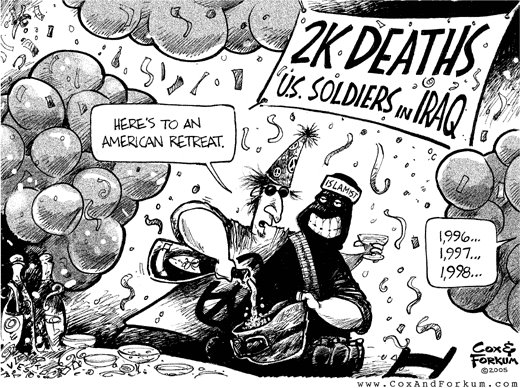
I've been thinking about the relationship between violence and freedom (V&F) for a while, and planned to eventually write about it, but the hub-bub over American casualties in Iraq prompts me to address the issue now. I saw this cartoon called "Grim Countdown" a couple weeks ago, and thought that it was totally inaccurate and unfair -- little more than some cheap demagogy by some right-wing fanatics.
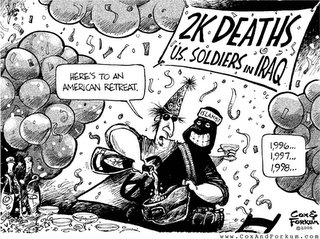
I know a bunch of people who publicized this symbolic milestone, and not a single one of them gave me any reason to believe that they actually welcomed the death of American soldiers. Yes, they used this milestone as an opportunity to make a political point, which seems a bit crass--but that's how politics works; the pro-Bush crowd also takes advantage of symbolic events to make the case that their views are correct.
A person is in an difficult position when they claim that the government's policies are disastrous for us; to justify themselves, they need to bring attention to the consequent disasters, and risk giving the impression that they welcome these disasters. It's unfair and unwise to criticize them on those grounds.
In all the fuss over the 2,000 military deaths in Iraq, I came across a single (American) person who welcomed the deaths of these soldiers, and I only noticed this person because another anti-war commentator had pointed him out in order to condemn him.
I'll have more comments on that later.
I know a bunch of people who publicized this symbolic milestone, and not a single one of them gave me any reason to believe that they actually welcomed the death of American soldiers. Yes, they used this milestone as an opportunity to make a political point, which seems a bit crass--but that's how politics works; the pro-Bush crowd also takes advantage of symbolic events to make the case that their views are correct.
A person is in an difficult position when they claim that the government's policies are disastrous for us; to justify themselves, they need to bring attention to the consequent disasters, and risk giving the impression that they welcome these disasters. It's unfair and unwise to criticize them on those grounds.
In all the fuss over the 2,000 military deaths in Iraq, I came across a single (American) person who welcomed the deaths of these soldiers, and I only noticed this person because another anti-war commentator had pointed him out in order to condemn him.
I'll have more comments on that later.
Sunday, November 06, 2005
Political speech and Pittsburgh elections
"House Dems scuttled a bill that would have shored up protections for online journalists and bloggers. " Reactions include from "Thanks Jackasses" and "I, for one, welcome our soft-money-wielding Overlords". As I said before, I think that efforts to regulate political communications are misguided. I doubt that any prospective FEC regulations would interfere with the style of advocacy that I engage in, and I'll never be big enough to draw any attention anyway.
Still, this has prompted me to make my endorsements for this Tuesday's elections for Pittsburgh voters. After all, distributing political power is part of the point of this exercize (meaning, this blog), so, here it goes:
Mayor: What a crock. Bob O'Connor will win in a landslide, because this is a Democrat's city, and there's a good amount of stupid party loyalty to go around. The city is going to pieces, and Bob O'Connor is as much to blame for our problems as anyone. I'll probably cast a protest vote just for the heck of it.
Court of Common Pleas: Kathryn Hens-Greco. There are several positions up for election, but Hens-Greco is the only person who I know enough about to cast a vote for. I know a lot of people who know her, and have only heard good things about her. She's been endorsed by both of the local papers, some local activist groups, and the local bar association. From what I've heard, she stands out because she actually wants to serve on the Family Court, while most judges view the Family Court as a stepping stone to something bigger.
State Supreme Court: Several groups want voters to refuse to retain judges Newman and Nigro. I haven't seen enough evidence to vote against them, but they seem to have done enough to piss off a lot of folk (both conservative and progressive), so I just want to point this out.
Still, this has prompted me to make my endorsements for this Tuesday's elections for Pittsburgh voters. After all, distributing political power is part of the point of this exercize (meaning, this blog), so, here it goes:
Mayor: What a crock. Bob O'Connor will win in a landslide, because this is a Democrat's city, and there's a good amount of stupid party loyalty to go around. The city is going to pieces, and Bob O'Connor is as much to blame for our problems as anyone. I'll probably cast a protest vote just for the heck of it.
Court of Common Pleas: Kathryn Hens-Greco. There are several positions up for election, but Hens-Greco is the only person who I know enough about to cast a vote for. I know a lot of people who know her, and have only heard good things about her. She's been endorsed by both of the local papers, some local activist groups, and the local bar association. From what I've heard, she stands out because she actually wants to serve on the Family Court, while most judges view the Family Court as a stepping stone to something bigger.
State Supreme Court: Several groups want voters to refuse to retain judges Newman and Nigro. I haven't seen enough evidence to vote against them, but they seem to have done enough to piss off a lot of folk (both conservative and progressive), so I just want to point this out.
Friday, November 04, 2005
Communication: Distribution (preview)
Previously, I wrote about the importance of improving our ability to communicate, and specifically, how we do so by improving our ability to produce media content.
The next way to shape the information landscape of our society is to distribute media -- to help information consumers to find the stuff that they want. I'll cover this topic in a future post, but for now I invite you to check out a webpage called "I want to - a page of utilities that help you do stuff you want to". This webpage has tons of links to software and services that can help you to get information to others. The major topics include:
The next way to shape the information landscape of our society is to distribute media -- to help information consumers to find the stuff that they want. I'll cover this topic in a future post, but for now I invite you to check out a webpage called "I want to - a page of utilities that help you do stuff you want to". This webpage has tons of links to software and services that can help you to get information to others. The major topics include:
- Share stuff
- Manage myself more effectively
- Find things that I'd enjoy
- Do things with websites
- Create tutorials
- Do a bunch of other stuff
- Have a bit of a laugh
Saturday, October 29, 2005
Communications: production
A person's influence on society is heavily dependent on his ability to communicate with the general public. If we wish to improve our ability to communicate with the public, we can increase our effectiveness in producing media, distributing media, or consuming media. Below are a number of ideas and resources intended to help a regular person produce media--starting from the development of an idea until it is ready for public consumption.
Ideas and information can be packaged into several forms of media: speech, writing, music, drawings, and any number of combinations or derivative forms. As you may have guessed, my favorite medium is the written word, so I'll focus the most on that, but try to provide whatever information I can on those other media.
Writing:
The Internet provides all types of resources to help individuals improve their writing. At the most basic level, one can get free word-processing software, such as Open Office. Also, before writing, it is good to consider tips that can help in writing, such as Fifty (50!) Tools which can help you in Writing.
Once the first draft has been written, an editor can do wonders for improving it. Not only do editors improve the particular piece of writing that they are evaluating, but they also improve an author's writing skills. The Internet should make it easier for authors to work with editors, but I'm not aware of any system that matches amateur authors with editors. At the very least, an author can recruit someone with a shared interest to edit his work, and they can easily exchange material by email. A writer can also evaluate his work using automated readability tests.
The Online Writing Lab at Purdue has a number of resources for writing, including tips for editing and proofreading. As a final note, I think that the most important thing for a writer to do is keep his goals in mind, and put his ego aside and do what is necessary to accomplish those goals.
Cartoons!:
Cartoons are a great way to communicate to a large audience, especially if the message is simple or emotional, or the audience is not very literate. Cartoons also tend to be more fun than written works, which can encourage readers to show the cartoons to their friends.
I'm not an artist, so I can't recommend tips for making cartoons. All I can do is point to an example of how cartoons are being used to promote economic reform.
Animations!:
Even better than cartoons (sometimes) are animated cartoons. I've never made an animated cartoon, but I've seen some cool stuff and it apparently isn't too difficult to produce animations in Flash. We've seen what has been done by JibJab(This land), NoMediaKings (Time management for Anarchists), and some egg lover.
Unfortunately, it seems that the official software that produces Flash animations costs a few hundred dollars, but free alternatives are available: OpenOffice can export its "slide-show" presentations in Flash formats; Open Source Flash maintains information about open-source Flash projects, which seems to focus upon Eclipse (tutorial); there's also the proprietary but free, PowerBullet.
Audio:
I'm no musician, but I have edited some audio files using Audacity, and am pretty impressed with it. You can see a list of items that have been produced with Audacity. The rather new practise of podcasting has made it a lot easier to distribute audio to your audience.
Publishing:
Finally, once you've put together your content, you have to make it available to the public. The traditional way to do this is to publish flyers and newsletters. Publishing in these formats is easier than ever, but it is even easier to send out an email or set up a web-page.
Probably the easiest way to web publish is to use a blog. I've been happy with the free service provided by Blogger, and have found that their help files are rather comprehensive. Here are some tips on designing a weblog.
Once you've produced your media, you have to get it into the hands of the consumer. I'll address that in a future post. Stay tuned!
(subscribe to my XML feed using your feed reader)
Note: if this topic is interesting, you may be interested in my previous post on Thinking for Ourselves.
Ideas and information can be packaged into several forms of media: speech, writing, music, drawings, and any number of combinations or derivative forms. As you may have guessed, my favorite medium is the written word, so I'll focus the most on that, but try to provide whatever information I can on those other media.
Writing:
The Internet provides all types of resources to help individuals improve their writing. At the most basic level, one can get free word-processing software, such as Open Office. Also, before writing, it is good to consider tips that can help in writing, such as Fifty (50!) Tools which can help you in Writing.
Once the first draft has been written, an editor can do wonders for improving it. Not only do editors improve the particular piece of writing that they are evaluating, but they also improve an author's writing skills. The Internet should make it easier for authors to work with editors, but I'm not aware of any system that matches amateur authors with editors. At the very least, an author can recruit someone with a shared interest to edit his work, and they can easily exchange material by email. A writer can also evaluate his work using automated readability tests.
The Online Writing Lab at Purdue has a number of resources for writing, including tips for editing and proofreading. As a final note, I think that the most important thing for a writer to do is keep his goals in mind, and put his ego aside and do what is necessary to accomplish those goals.
Cartoons!:
Cartoons are a great way to communicate to a large audience, especially if the message is simple or emotional, or the audience is not very literate. Cartoons also tend to be more fun than written works, which can encourage readers to show the cartoons to their friends.
I'm not an artist, so I can't recommend tips for making cartoons. All I can do is point to an example of how cartoons are being used to promote economic reform.
Animations!:
Even better than cartoons (sometimes) are animated cartoons. I've never made an animated cartoon, but I've seen some cool stuff and it apparently isn't too difficult to produce animations in Flash. We've seen what has been done by JibJab(This land), NoMediaKings (Time management for Anarchists), and some egg lover.
Unfortunately, it seems that the official software that produces Flash animations costs a few hundred dollars, but free alternatives are available: OpenOffice can export its "slide-show" presentations in Flash formats; Open Source Flash maintains information about open-source Flash projects, which seems to focus upon Eclipse (tutorial); there's also the proprietary but free, PowerBullet.
Audio:
I'm no musician, but I have edited some audio files using Audacity, and am pretty impressed with it. You can see a list of items that have been produced with Audacity. The rather new practise of podcasting has made it a lot easier to distribute audio to your audience.
Publishing:
Finally, once you've put together your content, you have to make it available to the public. The traditional way to do this is to publish flyers and newsletters. Publishing in these formats is easier than ever, but it is even easier to send out an email or set up a web-page.
Probably the easiest way to web publish is to use a blog. I've been happy with the free service provided by Blogger, and have found that their help files are rather comprehensive. Here are some tips on designing a weblog.
Once you've produced your media, you have to get it into the hands of the consumer. I'll address that in a future post. Stay tuned!
(subscribe to my XML feed using your feed reader)
Note: if this topic is interesting, you may be interested in my previous post on Thinking for Ourselves.
Subscribe to:
Posts (Atom)